

The battle for gaming supremacy has always been a two-horse race between NVIDIA and AMD. But hold onto your headsets, because Intel just dropped a bombshell that could change the game forever. Get ready to meet XeSS 3, featuring Intel’s brand-new Multi-Frame Generation (MFG) technology.
This isn’t just another incremental update. This is Intel’s powerful answer to NVIDIA’s DLSS 3, and it comes with a killer feature that no one saw coming. Let’s break down what Intel Frame Generation is and why it’s such a massive deal.
What is This ‘Frame Generation’ Sorcery?
Imagine you’re watching a flipbook animation. The more pages (or frames) you have, the smoother the motion looks. In the world of PC gaming, high Frames Per Second (FPS) means buttery-smooth gameplay.
Traditionally, your graphics card works hard to draw every single frame from scratch. Frame Generation is a clever AI trick that works differently.
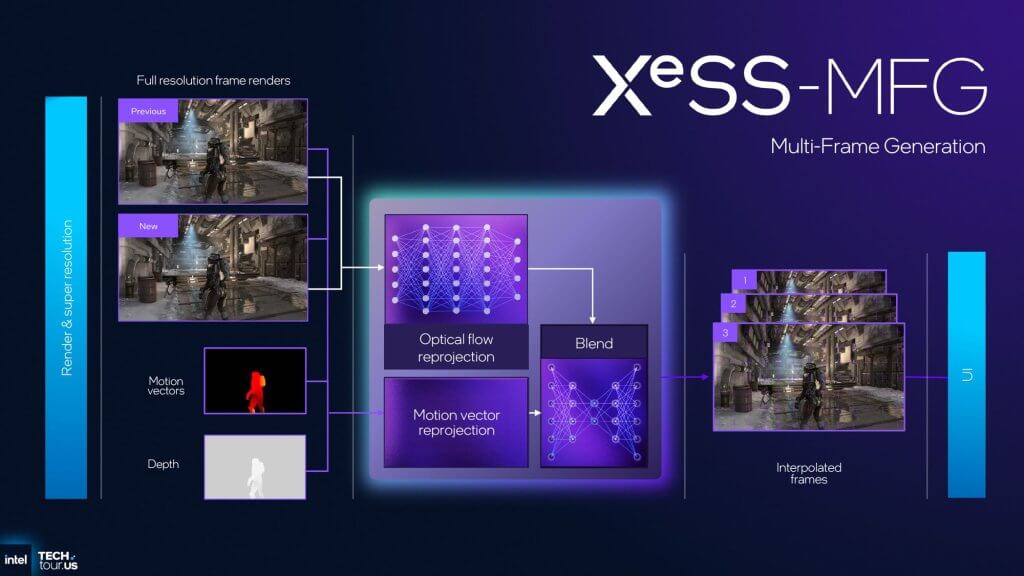
Think of it like a master animator. Instead of drawing every frame, the AI looks at two completed frames, analyzes the motion between them (like where a character is running or where a car is driving), and then intelligently draws a brand-new, synthetic frame to slot in between them.
The result? The number of frames you see on your screen skyrockets, making your game feel incredibly fluid and responsive, even at ultra-high settings.
Intel’s Big Play: Up to 4x Performance with MFG
So, how good is Intel Frame Generation? The company is claiming a mind-blowing performance multiplier of up to 4×.
Here’s how they do it: For every single frame your GPU traditionally renders, XeSS 3’s Multi-Frame Generation can create three additional synthetic frames. This means a game that was struggling at 30-60 FPS could suddenly be flying along at a silky 130-240 FPS.
This isn’t just about bigger numbers; it’s about transforming your gaming experience from choppy to flawlessly smooth, allowing you to crank up the graphics without sacrificing performance.
The Killer Feature: Why Intel’s Approach Changes Everything
This is the part that should have NVIDIA and AMD worried. While competitors often lock their best features to their newest, most expensive graphics cards, Intel is taking a different path.
Intel’s Frame Generation (MFG) is coming to ALL Arc GPUs with XMX cores.
Yes, you read that right. The support isn’t just for their future “Panther Lake” GPUs. It’s also coming to:
- Upcoming Arc B-Series desktop GPUs.
- The GPUs inside Core Ultra 200 series processors.
- And most importantly, it will be patched to support older Arc A-Series GPUs, like the popular A750 and A770!
This commitment to backward compatibility is a massive win for gamers. It means you won’t have to buy a brand-new GPU to get one of the latest and greatest features in PC gaming. Intel is the first to bring this level of support to its existing hardware lineup, making this powerful tech accessible to everyone.
More Than Just Frames: The Full XeSS 3 Upgrade Package
Intel isn’t stopping with frame generation. XeSS 3 is a comprehensive upgrade with more smart features under the hood.
✅ Seamless Game Support: Because the underlying technology is an evolution of XeSS 2, nearly 50 existing games that support XeSS will be able to take advantage of Intel Frame Generation on day one. No extra work is needed from developers!
✅ The Stutter Slayer: Intel is introducing a cloud-based system that pre-compiles game shaders. In simple terms, this means the driver automatically downloads optimized files for your games, drastically reducing those annoying stutters and long loading times on the first launch.
✅ Smarter Power for Laptops: With a new feature called “Intelligent Bias Control,” Intel’s chips will be much better at managing power between the CPU and GPU, leading to a smoother, more efficient gaming experience, especially on handhelds and laptops.
Is Intel’s Frame Generation the Real Deal?
All signs point to yes. With XeSS 3 and Multi-Frame Generation, Intel is no longer just catching up; it’s innovating and competing at the highest level. By offering a massive performance boost, smart software features, and—most critically—making it available to a wide range of new and old hardware, Intel has delivered a true game-changer.
The software war in the GPU space just got a whole lot more interesting.
What do you think? Is this the feature that will make you consider an Intel Arc GPU for your next build? Let us know in the comments!



oh that’s a great news.