
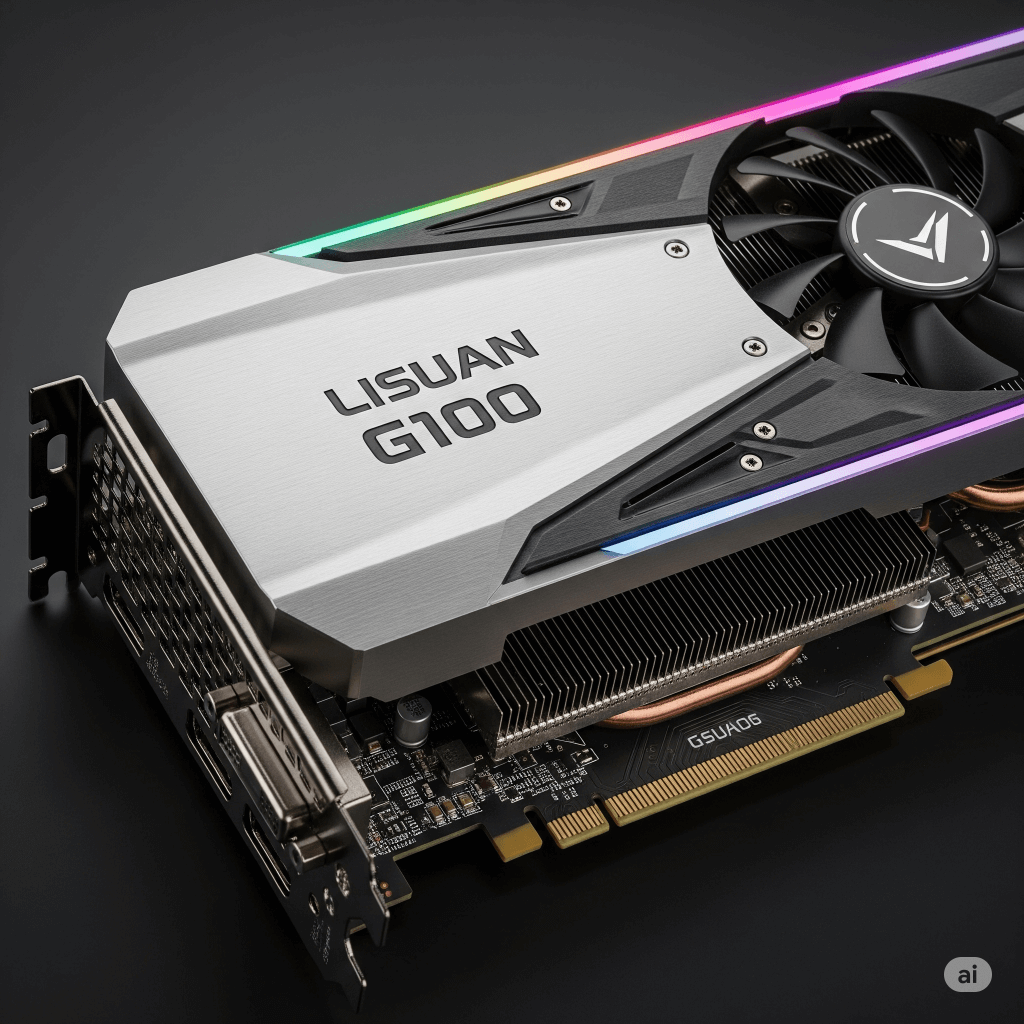
The world of graphics processing units (GPUs) is constantly evolving, with giants like NVIDIA and AMD dominating the market. However, a new player has emerged from China, aiming to shake things up: the Lisuan G100. Heralded as China’s first high-end gaming GPU, it has sparked considerable interest and debate regarding its potential to compete with established cards like NVIDIA’s GeForce RTX 4060.
What is the Lisuan G100?
The Lisuan G100 is a groundbreaking achievement for China’s semiconductor industry. It is the nation’s first domestically designed 6nm GPU, built upon Lisuan’s proprietary “TrueGPU” architecture. This development signifies a major step towards technological self-reliance for China, especially in the face of escalating global semiconductor competition and export controls. While the exact manufacturing partner isn’t officially confirmed, it’s widely believed to be SMIC, China’s most advanced foundry.
Performance Claims vs. Early Benchmarks
Initial excitement surrounding the Lisuan G100 stemmed from early reports and company claims suggesting its performance could rival, or even surpass, NVIDIA’s popular GeForce RTX 4060. However, initial real-world benchmarks have painted a different picture.
Early Geekbench OpenCL test results indicate that the G100’s current performance is significantly lower than anticipated, scoring approximately 15,524 points. To put this into perspective, this places its performance closer to that of a 13-year-old NVIDIA GeForce GTX 660 Ti.
Understanding the Performance Discrepancy
It’s crucial to understand why there’s such a gap between the initial claims and the early benchmark results. The Lisuan G100 is still in its nascent stages of development. The lower performance is primarily attributed to:
- Early Development Phase: The GPU is not yet fully optimized.
- Unoptimized Firmware and Drivers: Software plays a critical role in unlocking a GPU’s full potential, and the drivers for the G100 are likely still in their early iterations.
As development progresses, significant performance improvements are expected through driver optimizations and firmware updates.
Features and Future Outlook
Despite the current benchmark limitations, the Lisuan G100 is not without its merits. It is reported to support modern graphics APIs, including:
- DirectX 12
- Vulkan 1.3
- OpenGL 4.6
This compatibility makes it suitable for contemporary gaming titles and general-purpose GPU workloads, demonstrating its potential for future growth.
Looking ahead, Lisuan Technology has ambitious plans. The company aims to begin shipping small volumes of G100 cards in the third quarter of 2025, with mass production tentatively scheduled for 2026. This timeline suggests that while the G100 is still a work in progress, it represents a long-term commitment by China to establish a significant presence in the global GPU market.
Conclusion
The Lisuan G100 might not be an immediate RTX 4060 killer, but its existence marks a pivotal moment for China’s technological independence. It underscores the nation’s determination to innovate and compete in the highly competitive semiconductor landscape. As drivers mature and optimizations are implemented, the true potential of this Chinese GPU will become clearer. For now, it stands as a testament to China’s growing capabilities in high-end chip design and a fascinating development to watch in the future of gaming graphics cards.
Focus Keywords: Lisuan G100, Chinese GPU, gaming graphics card, RTX 4060 competitor, semiconductor independence