

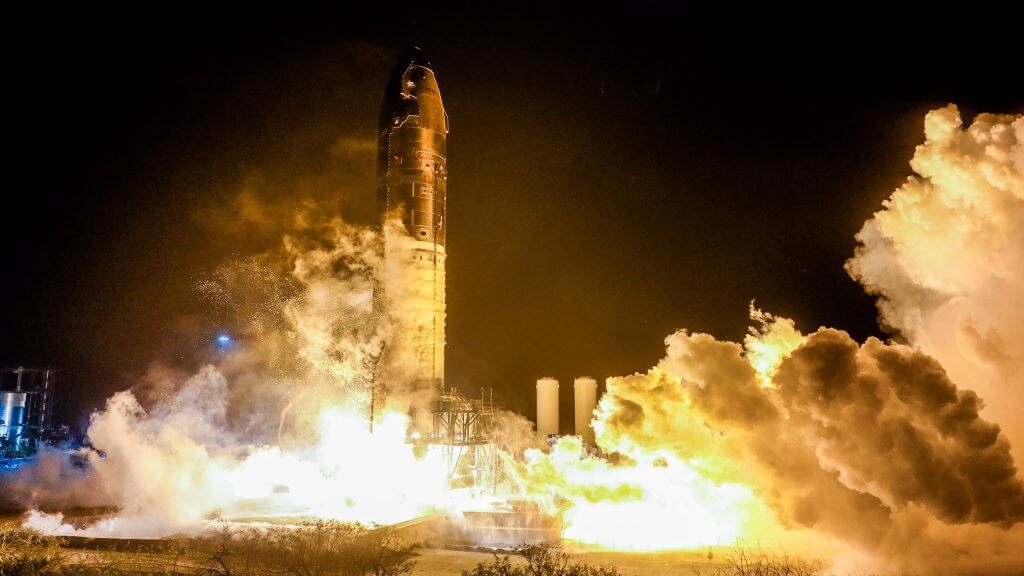
Boca Chica, Texas – The night sky over Starbase, Texas, transformed into a massive fireball yesterday as SpaceX’s second-generation Starship upper-stage spacecraft, Ship 36, exploded on the test stand. This fiery anomaly, occurring during preparations for a crucial static fire test, casts a new shadow over the ambitious Starship program and its ultimate goal of colonizing Mars. Starship Explodes
A Fiery Blast: What Happened to Starship?
The incident, which occurred late on Wednesday, June 18, 2025, sent shockwaves across the aerospace community. Ship 36, earmarked for the highly anticipated Starship Flight 10, was undergoing a critical static fire test. This procedure ignites the rocket’s powerful Raptor engines while the vehicle remains firmly anchored to the ground – a vital step to validate performance before flight. Footage captured by local media clearly showed fire erupting from the top of the rocket, quickly engulfing the entire vehicle in a spectacular, albeit concerning, display.
Elon Musk Identifies Nitrogen COPV as Cause
In the aftermath, SpaceX CEO Elon Musk quickly offered a preliminary assessment. He revealed on social media that “preliminary data suggests that a nitrogen COPV in the payload bay failed below its proof pressure.” COPVs, or Composite Overwrapped Pressure Vessels, are essential components in rocket systems. These lightweight, high-strength tanks store inert gases, like nitrogen, crucial for maintaining pressure inside the rocket’s main propellant tanks as fuel is consumed during flight. A COPV failure can be catastrophic, releasing immense stored energy. The fact that local media footage showed the fire originating from the upper part of the ship, precisely where the payload bay (and likely the COPV) is located, aligns with Musk’s initial assessment.
A Rocky Road: Starship’s Second-Generation Setbacks
This explosion marks another significant hurdle for the second-generation Starship design, which has encountered a series of challenges in its test campaign this year.
- Flight 7 (January): The ship failed to shut down its engines after separating from the Super Heavy booster, ending in an explosion.
- Flight 8 (March): Similar to Flight 7, the ship again failed to perform a controlled engine shutdown post-separation, leading to another loss.
- Flight 9 (May): While showing improvement by successfully shutting down its engines and cruising into space, the ship ultimately lost control during atmospheric reentry. This prevented crucial testing of its heat shield and control surfaces, and SpaceX could not attempt the planned launch tower catch for reusability.
Ship 36, the vehicle lost in yesterday’s explosion, had already completed a single-engine test to simulate an in-space engine reignition – a critical maneuver for future missions that was notably skipped during Flight 9.
Immediate Impact: Delays and Damage to Test Site
Had yesterday’s static fire been successful, Flight 10 could have launched as early as June 29th, a remarkably short turnaround from Flight 9. This would have demonstrated significant progress in SpaceX’s rapid iterative development approach. Now, that timeline faces an inevitable delay.
Beyond the loss of Flight 10’s vehicle, concerns mount over potential damage to SpaceX’s Massey’s ground testing site. While the full extent of the damage remains unclear, the sheer scale of the explosion captured on camera suggests significant impact. This could necessitate the use of alternative testing facilities for future static fire tests, further impacting the program’s schedule. SpaceX has confirmed that “all personnel are safe and accounted for,” and crews are actively working to clean up the site and ensure no hazardous materials remain.
“Just a Scratch”: SpaceX’s Resilient Approach
In a typically understated remark, Elon Musk described the explosion as “Just a scratch.” This seemingly nonchalant comment reflects SpaceX’s well-known “fail fast, learn faster” philosophy. The company embraces high-risk testing, viewing each anomaly as an invaluable data point to iterate and improve.
However, the continued setbacks with the second-generation Starship raise questions about the path forward. In a previous presentation, Musk expressed confidence that a third-generation Starship would resolve most of the program’s lingering issues. The current situation leaves open the possibility that SpaceX might accelerate its focus on the third-generation design, potentially shelving further extensive testing with the current iteration.
The Road Ahead: Perseverance for Martian Ambitions
Despite the spectacular setback, SpaceX’s ambition remains undimmed. Starship is not just a rocket; it is the cornerstone of humanity’s multi-planetary future, integral to NASA’s Artemis program for lunar landings and SpaceX’s long-term vision of colonizing Mars. While the recent explosion undoubtedly represents a significant challenge, SpaceX has a history of rapid recovery and learning from such events. The investigation into the COPV failure will be thorough, and the insights gained will undoubtedly contribute to a more robust and reliable Starship. The journey to the stars is never easy, and Starship’s path continues to be a testament to the perseverance and audacious spirit of space exploration.
For Regular Tech updates, follow our website and social media handles.